Simplifying Complex Flows Without Compromising Security
Context
Designing for critical use
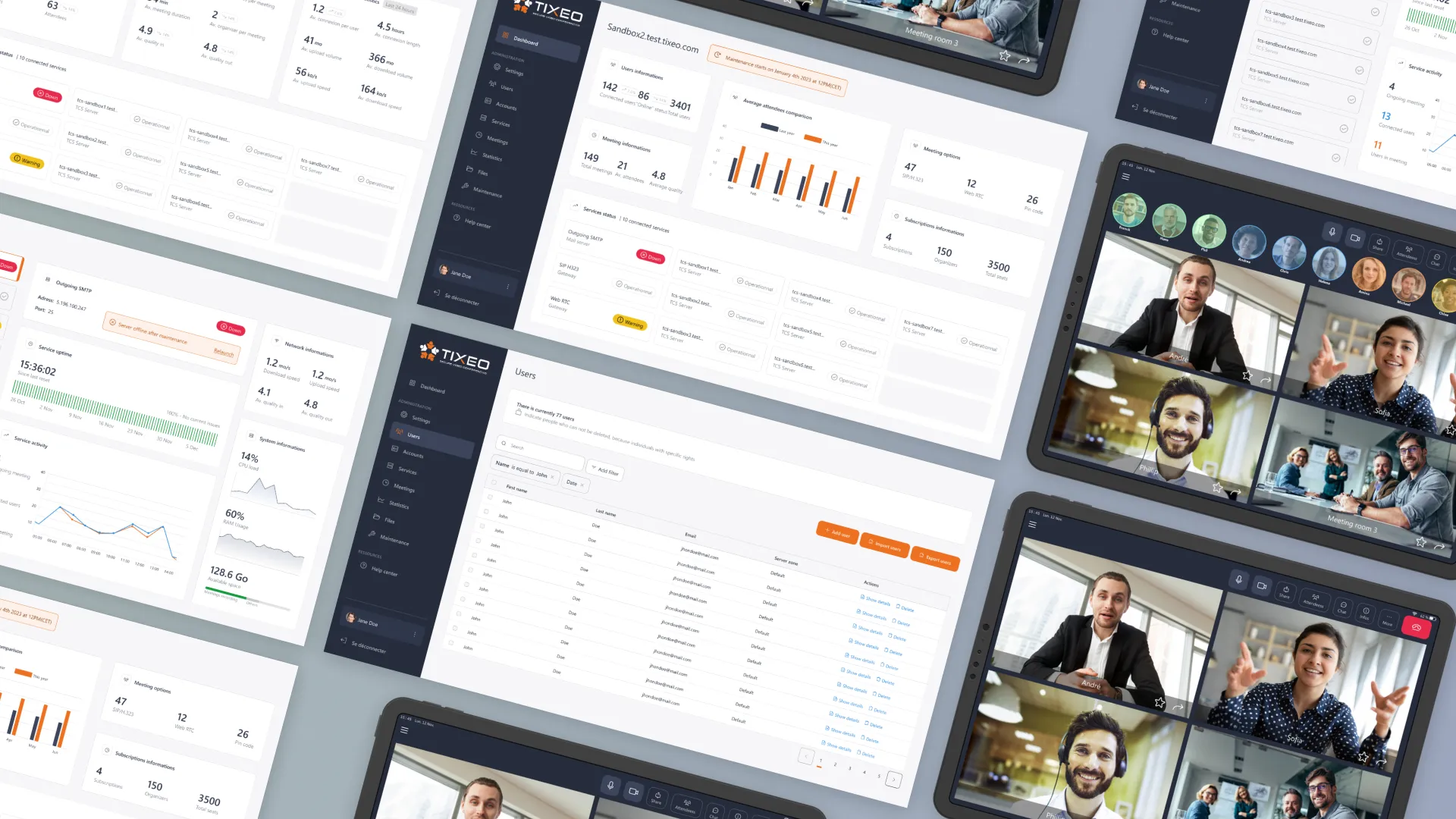
Tixeo is a secure video conferencing solution for organizations with strict data sovereignty requirements (government, defense, healthcare). Mission: design user experiences in a context where security and technical constraints severely limit design choices.
The challenge
When technical requirements meet UX
The challenge was to reconcile two often contradictory imperatives: meeting security and sovereignty requirements while offering a smooth and intuitive user experience. B2B users in critical environments expect absolute reliability without compromising usability.
Technical constraints (end-to-end encryption, on-premise architecture, highly secured environments) imposed strict limitations on available interactions, latency, and features. Every design decision had to be technically validated before implementation.
My role
UX & UI Designer
I joined Tixeo as a product designer on B2B interfaces. My role was centered on designing user experiences within strict technical constraints, in close collaboration with the development team in a Scrum framework (3-week sprints).
01 User research in a constrained context User interviews and observation in real usage conditions to understand the specific needs of B2B profiles (government, defense, sensitive organizations) and identify friction points in existing flows.
02 Critical interface design Design of interfaces for key features (meeting management, secure sharing, advanced settings) while accounting for security constraints and the need for absolute reliability.
03 Close technical collaboration Daily work with the dev team to validate the technical feasibility of every design decision, iterate quickly based on constraints, and find elegant compromises between experience and security.
04 User testing and validation Regular testing with real users in their working environments to validate solutions and identify areas for improvement before each release.
05 Documentation and handoff Production of detailed specifications and documentation to facilitate implementation and ensure consistency between design and development.
Design decisions
Designing with constraints, not against them
Understanding usage in critical contexts
Interviews and observations were conducted with users in real situations (government meetings, telemedicine sessions, defense video calls) to identify critical moments in the flow.
The main insight: in these contexts, reliability comes first. A bug, a latency issue, or an unclear feature can have serious consequences. Users tolerate a minimal interface as long as it is predictable and stable.
Turning constraints into advantages
Rather than seeing technical constraints as obstacles, they became design guides. End-to-end encryption introduces latency? Make the connection status ultra-visible. On-premise architecture limits cloud features? Focus on the essentials and do them perfectly.
Each feature was designed to minimize friction points while respecting security requirements. Design choices favored clarity and predictability: immediate feedback on critical actions, explicit connection states, simplified flows for recurring tasks, detailed error handling without exposing sensitive information.
Close collaboration with developers enabled rapid iteration and elegant compromises between user experience and technical constraints. Each sprint included co-design sessions to validate feasibility before finalization.
An invitation flow — Blurred for security reasons
Impact
A balance found between security and usability
- Reduction in usability-related support tickets, proving that flows are better understood and generate less friction
- Larger-scale deployments with clients, with better adoption of the solution within organizations, extending usage to more services and users
- Systematic technical validation, with 100% of designs technically validated before implementation through dev collaboration
- Complete documentation and smooth handoff, facilitating implementation and reducing back-and-forth
Reflections
Constraints stimulate creativity
Technical limitations are not blockers — they force prioritization and drive elegant solutions within a constrained scope. Designing under constraint means focusing on the essential and eliminating the superfluous.
Dev/design collaboration changes everything
Working closely with developers from the beginning of the process makes it possible to anticipate constraints, iterate faster, and find smart compromises. The design system cannot exist in a silo — it must be co-built with those who implement it.